MIND was an Erasmus+ KA2 small‑scale partnership (2025–2026) coordinated by European Youth Centre Břeclav (EYCB, Czech Republic), Udruga Better Me (Croatia), NaturKultur e.V. (Germany), Európa Ifjúsága Egyesület (Hungary)
We would like to share its core outputs in the following article, which were designed to be practical, digital and ready to use immediately:
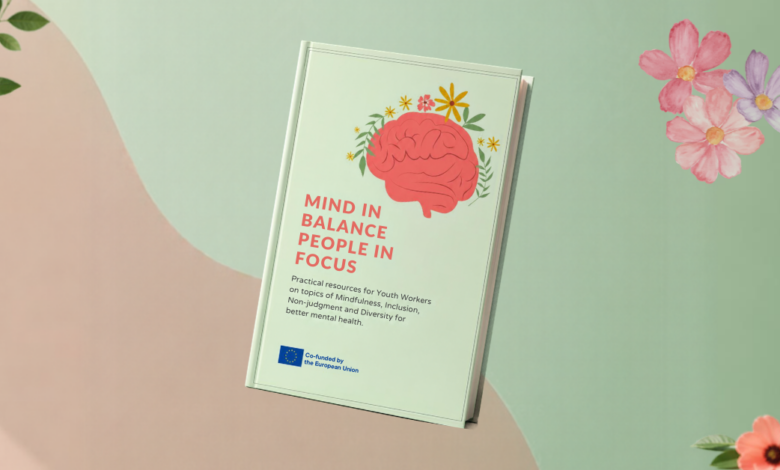
- MIND booklet (https://eycb.eu/wp-content/uploads/2026/06/MINDBooklet.pdf) – a comprehensive resource with methods, reflections and tools on mindfulness, inclusion, non‑judgment and diversity for mental health in youth work.
- Podcast and audio resources – guided meditations (https://www.spreaker.com/podcast/2-mind-meditations–7255942), personal stories from youth workers and young people (https://www.spreaker.com/podcast/3-mind-personal-stories–7262804) which can be used as motivational content and mindfulness exercises that youth workers and young people can use independently or in sessions.
These outputs directly respond to identified needs: stigma around mental health, uneven access to services (especially in rural areas), and the lack of practical tools for youth workers.
The MIND booklet: what’s inside and how to use it
The MIND booklet (https://eycb.eu/wp-content/uploads/2026/06/MINDBooklet.pdf) as one of the project’s outputs, intended as a ready‑to‑use handbook for youth workers, educators and NGO staff.
Booklet’s content is structured around:
- Foundations of MIND
Clear explanations of mindfulness, inclusion, non‑judgment and diversity, linked to mental health, European citizenship and employability. - Non‑formal education methods
Interactive activities, role‑plays and simulations that integrate MIND principles into everyday youth work. - Program design guidance
Templates and tips for setting learning objectives, developing lesson plans and evaluating outcomes of MIND‑based programs. - Inclusion and diversity strategies
Practical approaches to foster inclusive environments, promote diversity and empower marginalized groups (including LGBTQIA+ young people, refugees and those with disabilities). - Dissemination and local implementation
Ideas and examples for engaging young people in mental health activities beyond the project, at local and European levels shared by partners of this project.
How to use it:
- As a training manual for staff meetings, local workshops or partner exchanges.
- As a reference when designing new activities or adapting existing ones to be more mindful and inclusive.
- As a shared resource across organizations, enabling consistent language and methods when working on mental health topics.
Podcast and audio resources: bringing MIND into daily practice
The second output of MIND project is a set of podcast episodes and audio materials produced by Udruga Better Me in Croatia.
In these podcasts you can dive into:
- Introduction to the MIND project (https://www.spreaker.com/podcast/1-welcome-to-mind–7262846) where you can hear more about the projects vision, goals and values.
- Guided mindfulness exercises (https://www.spreaker.com/podcast/2-mind-meditations–7255942) (breathing, body scan, grounding practices) that youth workers can use at the start or end of sessions.
- Interviews and reflections (https://www.spreaker.com/podcast/3-mind-personal-stories–7262804) with youth workers and young people on mental health, inclusion and non‑judgment in practice.
How to use audio resources:
- Play a short guided practice (3–5 minutes) as a regular opening ritual in youth clubs, schools or residential exchanges.
- Share episodes with young people as self‑support tools they can listen to privately.
How organizations and trainers can use MIND outputs
For youth organizations
- Integrate MIND into existing programs
Use the booklet and session plans to add a mental health and inclusion lens to current activities (youth exchanges, local clubs, volunteering projects). - Train your staff and volunteers
Organize internal workshops using MIND materials to build shared language and skills around mindfulness, non‑judgment and inclusive facilitation.
For trainers and educators
- Adopt session plans
Pick specific activities from the MIND toolkit that match your group’s needs and context, and adapt timing, language and materials accordingly. - Combine with other resources
Link MIND methods with existing mental health guides, nature‑based approaches or digital tools to create richer, context‑specific programs.
For young people and peer leaders
- Use audio resources independently
Guided meditations and podcast episodes can support self‑care and reflection outside formal sessions. - Lead peer activities
With support from youth workers, young people can facilitate simple MIND‑inspired activities (check‑in circles, mindful walks, inclusion maps) in their schools or communities.
Accessing and sharing MIND resources
The MIND project’s outputs are intended to be freely accessible and shareable, in line with Erasmus+ open‑education principles.
Key access points include:
- eycb.eu/mind/ – project overview, training course information and links to outputs.
When using these resources, organizations are encouraged to:
- Credit the MIND project and partners (EYCB, NaturKultur, Udruga Better Me, Európa Ifjúsága Egyesület).
- Adapt content to local contexts while preserving the core MIND principles.
- Share adaptations back to the network to support continuous improvement and sustainability.
From outputs to impact: what changes because of MIND?
The ultimate goal of MIND’s outputs is not just to exist, but to impact in practice:
- Youth workers gain concrete tools and confidence to address mental health in inclusive, non‑judgmental ways.
- Young people, especially in rural and under‑resourced areas, experience more supportive environments and better access to mental health information and peer support.
- Organizations strengthen their capacity to design and implement mental health programs, and to collaborate across borders.
By focusing on practical, digital and sustainable outputs, the MIND project ensures that its impact extends well beyond the project’s lifetime.
Funded by the European Union. Views and opinions expressed are those of the authors and do not necessarily reflect those of the European Union or the Czech National Agency for International Education and Research (DZS).